

WINMAU dropped the Blade 7 range last week and wasted no time putting its flagship version centre stage.
The company claimed two decades of development and roughly ten million test darts, with AI analysis and input from top players. Stage boards were already being trialled quietly on selected Pro Tour occasions earlier in the year.
On 13 November the manufacturer confirmed the full collection: a standard single-core Blade 7 at £59.99, a Dual Core 360 at £69.99, and two triple-core 7T models at £89.99. The Blade 7T Stage Edition became the official PDC stage board with immediate effect, making its debut at the Grand Slam of Darts in Wolverhampton. Its sibling, the 7T Championship Edition, will take over as the official ProTour board from 2027.
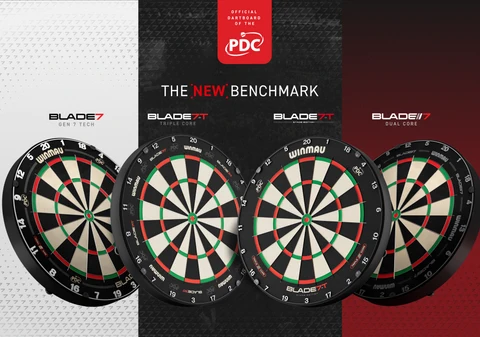
The PR push was textbook and timed perfectly. Winmau, the PDC and retailers flooded social channels with “new benchmark” messaging. Key talking points included 15% longer East African sisal fibres, a 15% thinner outer bull ring, 60-degree angled wiring designed to guide darts into the bed, and Triple Core technology for the professional editions.
The launch deliberately replaced the short-lived Blade X and Blade 360 lines, which had drawn heavy fire for bounce-outs. Gary Anderson’s blunt “absolutely rank” verdict after the World Cup of Darts still echoed.
AIM180 have had few such issues and have found the Blade360 to be an exception home and testing board; see our comments and introductory reviews on our YOUTUBE Channel
Winmau’s response to those earlier complaints had leaned on independent data showing fewer rejected darts; the Blade 7 is clearly positioned as the corrective chapter.
Early reaction mixed relief with residual scepticism. Social feeds lit up with “Blade X is gone” celebrations and cautious hope that the seventh generation would restore the trust the Blade 6 once enjoyed. Some players and fans welcomed the thinner wiring and denser sisal claims.
Retailers reported solid pre-order interest in the Stage Edition, which carried a short window before wider availability.
By the opening night of the Grand Slam, the new board was already under the bright lights and television cameras. Whether the retention and consistency claims hold up over a full season of heavy professional use remains to be seen, but the timing could hardly have been better.
A major televised event, a clear product hierarchy for home and pro players, and a narrative of continuous refinement after a shorter-lived previous generation.
Seven generations of the Blade name now sit on the market. The Stage Edition is the one the world is watching.
Images: WINMAU