
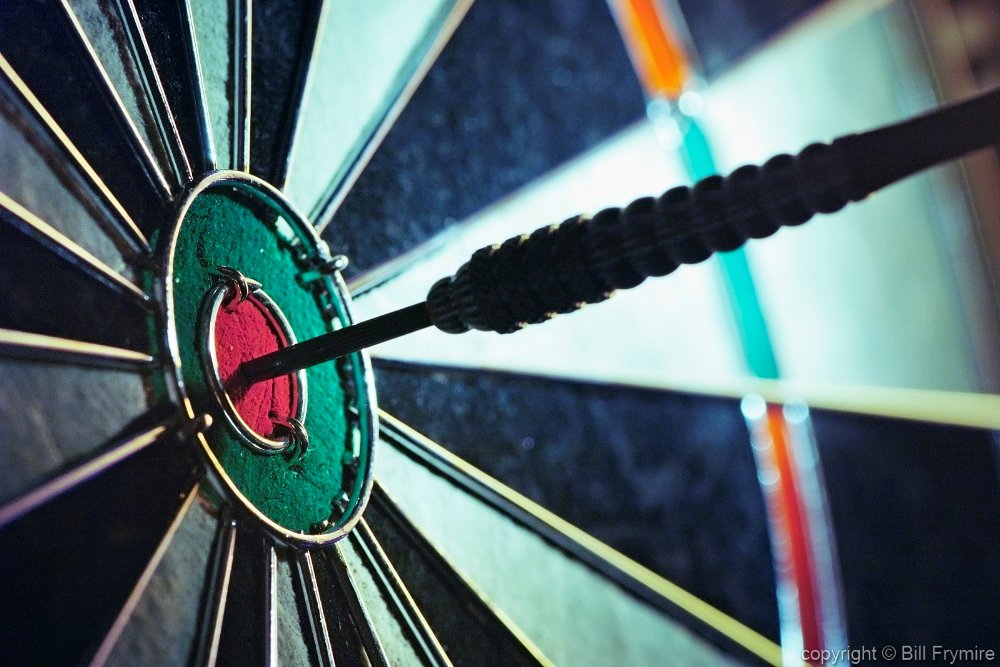
SEVERAL situations within a leg of match darts (01 variations) result in last dart switch to the bullseye ring being very useful indeed.
Whether it’s ensuring you end up on a two darter – instead of three – or even you having the chance to finish at all, basically a cover shot with two possibly positive outcomes, this is BullShifting.
In-Game Example:
You are on 201(and your opponent is not yet down to a score where adding pressure might be relevant) and you hit t20 and s20 with darts one and two, leaving 121 remaining and a single dart in hand.
A dart in either the 25 or Bullseye , (i.e. a BullShift) will leave you with a handy two darter (either 96 or 71) whereas a single twenty or a stray (caused by a deflection, obviously!) will likely leave you with a tricky three darter amd perhaps more complex treble possibilities.
There are many other situations where two at the 20s segment (more variations later) and one at the bull/25 ring will be required:
These may include shots at 170, 130 to finish or 90, 105, 130, 145 or even 170 to set up a finish next turn.
So, it’s important to be be a bit of a BullShifter after all, esp with your last dart!
Game Overview:
Although I prefer drills to be based around five turns, this one really has to involve at least 6. For each turn you will take two darts at the twenties and one dart at the Bullseye ring.
There are six possible outcomes if you hit the twenty bed twice & BullShift: 170, 145, 130, 105, 90 and 65.
Each time you hit a score it is removed from the scoring options. As an incentive, however, and to give every throw meaning, the Bullseye counts as 50, if hit with the last dart (LDB), even if you have repeated a score or not put two in the twenty bed.
Perfect Example:
- Turn 1: T20 T20 Bull – 170
- Turn 2: T20 T20 25 – 145
- Turn 3: T20 s20 Bull – 130
- Turn 4: T20 s20 25 – 105
- Turn: s20 s20 Bull – 90
- Turn 6: s20 s20 25 – 65
- Total – 705!
Realistic Effort:
- Turn 1: s5 T20 25 – 0
- Turn 2: s20 s20 25 – 65
- Turn 3: t20 s20 25 – 105
- Turn 4: s20 t5 Bull – 50
- Turn 5: s20 t20 Bull – 130 (repeat score)
- Turn 6: s20 s20 Bull – 90
- Total: 440
Variations:
You can vary this drill a number of ways. But beware of driving yourself into a fit of frustration.
A harsh variation is to list the possible numbers on your marking board / screen, 65 -170 inc. and then give yourself a set number of throws to knock them all out.
Example: use 10 turns and mark how many 65’s, 90’s etc. that you make. But also mark how many times you miss the twenty bed with either of your first two and how many last dart bulls (LDBs) you manage!
Levels:
As you can see from the variations above you can set your own level and then simply try to better your best. Total score after 6 turns, number of finishes hit after 10 turns etc. But here is a guide:
- Amateur: 1 lower BullShift (65 or 90) and a LDB. 115 to 140
- Pub Team: 1 or 2 BullShifts and a LDB. 115 to 220
- Higher: 2 or more BullShifts and a LDB. 250 or more
- Elite: 3 or more Bullshifts and a LDB. 400+ (often!)
Records:
Who is the biggest BullShifter?
Top Score: 615 (145, 130, 65, 170, 0 & 105)
A former Pro Tour finalist we worked with, who has competed at BDO, PDC and WDF World Championships, is a phenomenal Bullseye hitter when on form.
However, our hero can stray a little, while scoring indicating the above record mark was set when he was in very good touch indeed.
Fewest Turns: All six BullShifts were taken out in only 11 turns by a player who has flirted with the PDC top 32 but flew a little too close to the sun.
Originally published for the dartsworld.com Darting Isolation Series during the Covid-19 Lockdown of 2020.